
Jimmy’s Fitzroy Crossing 2024 Scholarship tour & Brahman Week
Contributed by James Mahoney
On the 7th of October 2024, myself and Wes Wortley travelled and landed in Rockhampton, Queensland to begin our 10-day scholarship over Brahman week. This trip included visiting vendor properties, bull/heifer sales and meatworks.
We started the week by first visiting CQLX (Central Queensland Livestock Exchange) for its Rockhampton Brahman Week Sale. Here we were looking at Bulls with Johnny Edwards and learning about what he focuses in wanting for a Stud breeding bull for his Queenslander line.
The following day, we travelled to Steve Farmer’s property – SC Droughtmaster Stud. Here we got to do a farm tour and get an understanding of what goes into the preparation and feeding of young bulls.
Later that evening, we drove to the French Brahmans T Division Female Sale at ‘The Great Western’ in Rockhampton. This was such an eye opening, exciting sale, getting to witness heifers being sold for such a strong bidding presence.
We started out at CQLX, feeding and organising a truck for the bull Johnny purchased back to Gayndah. After that we went to Rocky Repro (semen collecting and storage facility).
This is where studs take their bulls to get “milked” (semen collected), tested and frozen. At the facility they do a lot of importing and exporting semen, to export semen the bull must go through all the same processes and vaccination’s as if the bull itself was going to be exported.
The bulls can be held at the property for up to 100 days and be milked every day, until they have a desired amount of straws. This facility is so large it can hold millions of straws inside, to be exported all over the globe.
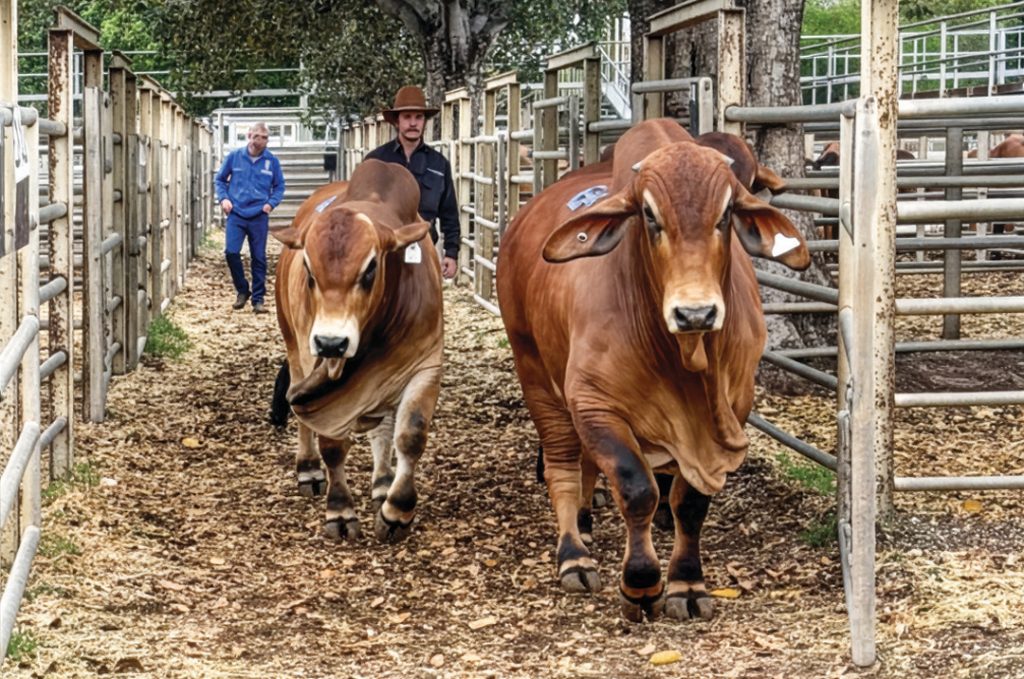
On one of the days, we travelled to Clermont for the first Queenslander and Tropical Red Invitational Bull Sale. When we arrived, we helped with preparing the bulls for the sale. This included washing them, painting numbers on and penning up into designated areas.
The sale was held on the 12th of October. This sale wasn’t very successful with only 30 out of 104 bulls being sold during the sale. However, over the next few days afterwards, all bulls were able to be sold privately, so no vendors had to take any bulls home.
We travelled down south and completed farm tours of Barlyne, Barboot and Muan which included Big Meats their abattoir, and the feedlot set up where vendors send their bulls for feeding and to get quiet and be around people before they are sold.
We then travelled to the vendor, Michael Flynn (Valeravale Droughtmasters) in Ipswich. We went to one of his properties where we drafted off his stud bulls and got to in person help/watch him collect semen from the bulls and be counted/studied under a microscope on property.
Michael also went into detail explaining the benefits of morphology, including potential fertility issues. Allowing producers to select bulls with higher quality sperm, leading to increased calving rate, tighten calving periods and ultimately improved herd productivity by ensuring more cows become pregnant and produce good healthy calves.
We spoke in length about the positives of having strong herd genetics, including increased production efficiency through faster growth rates, better feed conversion, higher carcass quality, improved disease resistance and better reproductive performance. Things also like enhanced adaptability to their environment and the ability to select specific traits, like temperament, horn, rib fats and scrotal size.
To finish out the tour we where lucky enough to get a tour of JBS Processing Plant at Dinmore. Dinmore is the largest beef abattoir in the southern hemisphere, with daily production of 3,350 head per day and an onsite staff base of approximately 2000 people. Making it the largest employer in the Ipswich region.
The processing plant underwent a $50 million upgrade in 1999, bringing in some of the most advanced technology in the industry to improve daily production. The Dinmore processing plant is located in Ipswich, which is less than an hour from Brisbane ensuring they can always export their meat across the whole of Australia.
It was great to see the behind scenes of all the hard work that goes into preparing the bulls that come over to Fitzroy Crossing Bull Sale every year. A bull sale is not just a one-day event. The process starts way back to when the calf is born. Continuous data is reported from day 1, to first identifying its mother, to weight, its class, growth and progress. Bull studs not only just produce high quality bulls, a lot are self-sufficient with growing their own pastures for silage through pivots.
Bull Studs are such a diverse enterprise; with each stud focusing in different areas, allowing there to be certain bulls for certain clients based on such a broad production desire. Each sale has designated bulls to be sold, depending on the production/environment they are trying to reach.
I will forever be grateful for this experience; this has been a once in a life time opportunity. I learnt so much over the 10 days that will help me in my future career. I would especially like to thank all the vendors, and the Fitzroy Bull Sale Committee for the chance to travel to Queensland to see each personal process.
Wes’ Fitzroy Crossing Scholarship tour and Brahman Week 2024
Contributed by Wes Wortley
Day 1
The first day of our trip started in Rockhampton where myself and James landed at 7am, where we were met by Johnny Edwards from Barlyne Pastoral.
Our first stop was the Brahman Week Bull Sale, after only seeing the Fitzroy Bull Sale it came as a shock to see how large the facilities were. Johnny walked us around the sale pens examining bulls and introducing us to various stud owners and vendors, while taking us into the detail about the criteria of traits and characteristics he looks for when selecting bulls for his herd.
There were 752 Bulls in the sale and while we only stayed around for a few hours of the sale it was an amazing experience. That afternoon we travelled just outside of Rockhampton to the Karinya Sale Yard where we looked at their selection of Grey Brahman Bulls that would go under the hammer the following week at their own sale.
Day 2
We had the opportunity to go out to Mt Elsa, Steve Farmer – SC Droughtmasters Stud, where we were given a tour of his property. Steve talked us through is operations at Mt Elsa, from centre pivots, commercial Droughtmasters, Stud Droughtmasters, Wagyu and a mixed mob of Brahmans.
We were also given the opportunity to see Steve’s Stud Droughtmaster sale team for the Nebo Bull sale.
Day 3
After watching the closing of the 2024 Brahman Week Sale, Steve Farmer had organised a trip out to Rocky Repro where we met the operations manager, George North. He gave us a tour of the centre and the bulls living at the centre while they collected semen. He also showed us how they collect and analyse the semen samples, along with the storage shed and how the samples are stored.
We then travelled to Clermont for the preparations of the first Queenslander and Tropical Red Bull Sale. This is also where we caught up with Jimmy Edwards from Barlyne Pastoral and Darren Castle of Bar Boot Brahmans.
Day 4
Once In Clermont we had to set up for the upcoming sale the following day, during this time we met different vendors and painted and washed bulls for the sale.
Day 5
The Clermont Queenslander and Tropical Red Bull Sale was run by Jake Kennedy at Kennedy Livestock & Property, this sale had an offering of Grey/Red Brahmans, Droughtmasters and Queenslanders.
During the sale me and Jimmy were part of the crew supplying the bulls to the sale ring. This was the first Queenslander and Tropical Red Bull sale, and it didn’t go as well as everyone had hoped, with a lot of the lots being passed in. This was an eye-opening experience into the struggles of first-time sales and the struggles some vendors face when selling their cattle to a new market.
Day 6
We drove from Clermont to Barlyne Pastoral and on the way stopped in a Smart Berries Mundubbera Blueberry Farm where we given a farm tour by Johnny’s sister Sally and her husband Kirk who run and manage the farm. We then continued our trip to Barlyne.
Day 7
Johnny took us to a block that houses his weaner heifers and steers, while we were there we rotated the heifers and had a bit of a walk through on what criteria Johnny goes through to select which heifers he keeps for the breeding herds.
We also brought in the steers to be separated into different weight groups as Johnny was looking to fatten them up for sale.
Once back at Barlyne we had a tour of the property, Johnny showed us some of the different paddocks and water points as well as a few of his breeding herd and stud cows.
Day 8
After an early start we were heading for the Gibbs Family (Muan Brahmans) Big Meats Abattoir in Biggenden. Where we were lucky enough to be given a tour of their facilities.
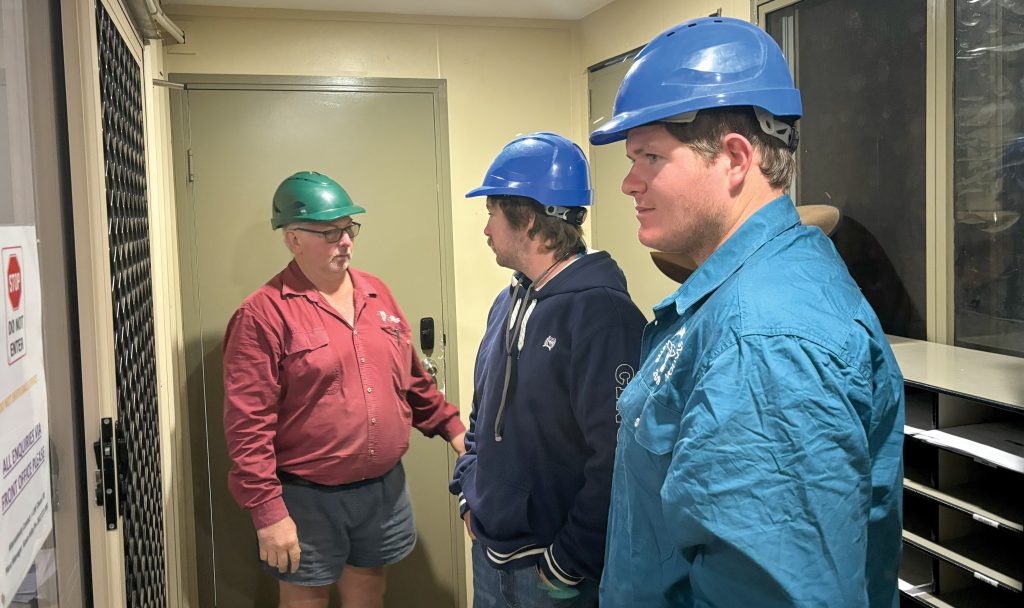
We then headed down to the feedlot where we were shown how they introduce cattle into the feedlot and what processes are in place in regards to data collection and processing. Also being able to look at the 2024 batch of future bulls in the feedlot.
A short drive down the road was the main operation of Muan Brahmans where we were met by Lenny Gibbs the owner, he gave us a tour of the onsite bull feedlot where he agists other people’s bulls for future sales and also their stud Brahman cows, weaner heifers and stud bulls.
I found this part of the trip very interesting as the Gibbs family have got a whole operation set up, from farm to feedlot and then to meat works, while also supplying quality bulls for sale.
Once finished at Muan we travelled back to Gayndah to another block of Barlyne’s called Kajabbi where Johnny keeps a herd of Queenslander cows.
While there we checked fences and moved a mob of stranger cows back to where they belonged, following this we had a tour of Riverton Orchard across the river from Kajabbi.
Day 9
Leaving Barlyne early we travelled to Bar Boot Brahmans near Kingaroy where we met Darren, Jacqui and Tony Castle.
Tony then took us to put in a new boundary fence on a block that he had just started leasing. Once finished the fencing we returned to Bar Boot and waited for Michael Flynn from Valera Vale Droughtmasters to pick us up and take us to his small property in Milbong.
Day 10
On our way out to Michael’s bull preparation property Avilion at Greymare we stopped into the Silvervale sale yards where Micheal was wanting to buy a handful of small weaners to fatten up and then sell later on.
Once at Avilion we met John who is the farm manger at Avilion, he had already brought a selection of Droughtmaster bulls up to be drafted into culls and divided between Valera Vale, Avilion and Micheal’s home block.
We also had the opportunity to semen test two bulls. Michael is a vet and has done a lot of work in genetics in relation to cattle.
He explained to us how to record certain types of data and how that data is interpreted to predict certain qualities that bulls can put into is offspring, using this data he is able to keep adding different traits and qualities that he wants into his herd.
Day 11
Our last day of the trip we travelled into Brisbane to the JBS Dinmore Meat works. We were lucky enough to be given a private tour by the plant’s general manager Murray Wilson.
He gave us an introduction to the plant where they have 2000 staff employed at the plant at one time and over a 24 hour shift they were able to process 3500 head. He was able to show us the full extent of the plant.
We started at the end of the process and worked our way back. Seeing the storage and trucking areas, then into the packing and boxing area. It was interesting to see how automated the whole packaging and sorting system was as a conveyor fed the boxed meat into different locations based on the colour and grade of the meat.
Our next stop was the butchering floor where hundreds of people work together to break down the carcasses into different cuts. We then followed the line into the fridges where hundreds of carcasses are kept waiting to be transported to the butchering floor.
The last part of the tour was the killing floor where hundreds of people and machines worked to break down a whole carcass into one that was ready to be cut up.
Murray Explained to us that nothing goes to waste every product of the beast is used in some way. It was amazing to see the scale of the whole operation and hard to get your head around how quick and efficient their whole process really is.
Over the 11 days I learnt a lot of new things and also added onto current knowledge, I learnt about new techniques to pick out specific qualities in bulls, how to select different bulls for different types of country and different types of herds.
Dove into the side of cattle genetics, which I have never done much in before so it was really interesting to learn and understand that side of the industry.
We were able to experience a large scale bull sale and also a sale just starting up. It was a unforgettable experience and I would encourage anyone who is given the opportunity to apply for the scholarship.
I would like to give a special thanks the Fitzroy Crossing Bull Sale Committee for funding the scholarship and also a special thanks to Johnny and Rachael from Barlyne for organising everything on the QLD side.
I would also like to thank Jimmy Edwards, Robin Finger, Darren and Jacqui Castle, Michael and Tracy Flynn, Steve Farmer. Lenny and Sandra Gibbs and everyone who gave up their time to show myself and James around, teach us and help us understand a more technical and advanced side of the industry.
