
Explanatory Notes for EBVs in Sales Catalogues
Only GROUP BREEDPLAN EBVs with Accuracy (Acc)
can be validly compared between Brahman herds
Estimated Breeding Values (EBVs)
An animal’s breeding value is its genetic merit, half of which will be passed on to its progeny. While we will never know the exact breeding value, for performance traits it is possible to make good estimates. These are called Estimated Breeding Values (EBVs). They are expressed as the difference between an individual animal’s genetics and the genetic base to which the animal is compared.
Accuracy
An accuracy value is presented with every EBV and gives an indication of the amount of information that has been used in the calculation of that EBV. The higher the accuracy the lower the likelihood of change in the animal’s EBV as more information is analysed for that animal or it’s relatives. The following guide is given for interpreting accuracy:
Accuracy Range Interpretation
less than 50% – EBVs are preliminary and could change substantially as more performance information becomes available.
50 – 74% – medium accuracy, usually based on the animal’s own records and pedigree.
75 – 90% – medium-high accuracy. Some progeny information included. It is unlikely that EBVs will change much with addition of more progeny data.
more than 90% – high accuracy estimate of the animal’s true breeding value.
As a rule, animals should be compared on EBVs regardless of accuracy. However, where two animals have similar EBVs the one with higher accuracy could be the safer choice, assuming other factors are equal.
Traits
Birth
BWT: Birth Weight EBV (kg) is based on the measured birth weight of animals, adjusted for dam age. The lower the value the lighter the calf at birth and the lower the likelihood of a difficult birth. This is particularly important when selecting sires for use over heifers.
Fertility
SS: Scrotal Size EBV (cm) is calculated from the scrotal circumference measurements of males taken between 300 and 700 days of age. Values are adjusted to 400 days of age. This EBV is an indicator of male fertility in regards to semen quality and quantity. Higher (positive) EBVs indicate larger scrotal size. There is also a small negative correlation with age of puberty in female progeny and therefore selection for increased scrotal size will result in reduced age at calving of female progeny.
DC: Days to Calving EBV (days) is an indicator of female fertility based on the time between a cow’s first exposure to a bull and when she subsequently calved. Cows that calve late in the season or fail to calve are penalised. Lower (negative) EBVs are preferred indicating shorter days to calving for the sire’s daughters.
Selection Index
Each selection index describes a different production system/market scenario and relates to a typical commercial herd using Brahman bulls. All selection indexes are reported in units of net profitability per cow mated ($) for the production system/market scenario they describe.
Central Production Index (CPI)
- Self-replacing commercial herd targeting pasture finished steers (e.g. central Queensland).
- Selected heifers are retained for breeding so maternal traits are important.
- Steers target 580 kg live weight (315 kg HSCW & 10 mm P8 fat depth) at 27 months of age, while surplus heifers target 470 kg live weight (250 kg HSCW & 12 mm P8 fat depth) at 25 months
Live Export Index (LIVE)
- Self-replacing commercial herd targeting the live export markets.
- This selection index is designed for cattle run in extensive northern Australian environments.
- Selected heifers are retained for breeding so maternal traits are important.
- Steers target an export live weight of 300 kg.
When reporting polled test results from a SNP based test, the results will be reported as seen below:

Understanding BREEDPLAN Percentile Graphs
BREEDPLAN Percentile Graphs are designed to make it easier to compare an animal’s EBVs with the current breed benchmark. Instead of just looking at raw EBV values, these graphs show where an animal sits in the breed population for each trait.
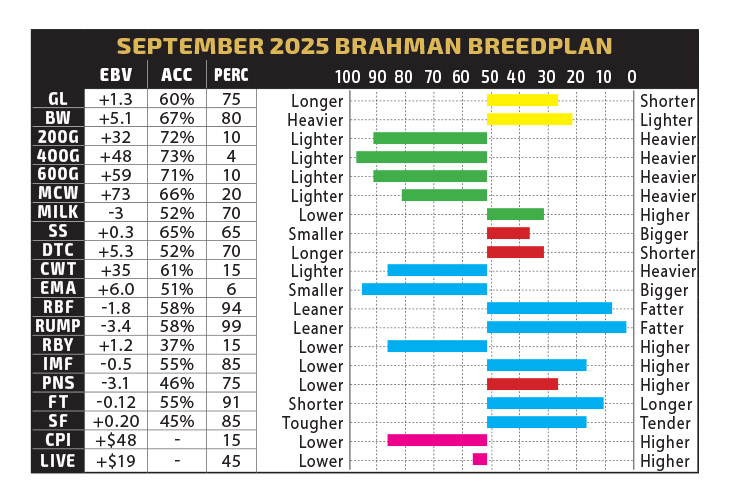
The Coloured Bars
Each horizontal bar represents the full range of EBVs recorded for that trait in the breed. The bar is coloured either to the left (lower values) or to the right (higher values) from the 50th percentile mark. The end of the bar shows the EBV of the animal you are assessing. The position of the bar tells you how that EBV ranks compared with other animals in the breed.
The colours on the EBV graphs represent the traits of the EBVs
- Yellow indicates Calving
- Green indicates Growth
- Red indicates Fertility
- Blue indicates Carcase
- Pink indicates Indexes
Percentiles
The scale below the bar shows percentile bands (Top 10%, 20% 30% down to 100%.). The bar ending further to the right means the animal ranks higher for that trait within the breed.
For example:
- If the bar for 400 Day Weight ends on the 10% line, that animal is among the heaviest 10% of the breed at 400 days.
- If the bar for Birth Weight is in the Top 30%, that animal has a lower birth weight than 70% of the breed, which may be desirable for calving ease.
Key Points to Remember
Not every trait should be selected for maximum values. For example, you may want moderate birth weight but high growth and fertility.
Always consider EBVs in relation to your own breeding objectives.
Use percentile graphs alongside raw data, visual appraisal, and structural assessment to make balanced selection decisions.
Understanding Median vs Average
It is important to know that the Brahman breed average and the percentile graphs ranking are different. Unlike the breed average, the percentile graphs are the median of the breed rather than the average.
It is useful to understand the difference between average (mean) and median.
Average (Mean): This is calculated by adding up all the numbers in a group and dividing by how many there are. It provides an overall picture but can be skewed higher or lower by a few extreme results.
Median: This is the middle value when all numbers are lined up from smallest to largest. The median shows the “typical” result and is less affected by extreme highs or lows.
For example, if most bulls in a group are priced around $10,000, but one sells for $50,000, the average will rise sharply, while the median will still reflect the more common price point.
Revision to Reportability of Australian Brahman EBVs
New Minimum Accuracy Thresholds for Reported EBVs
At the request of the Australian Brahman Breeders’ Association (ABBA), the minimum accuracy thresholds required for publication of all BREEDPLAN Estimated Breeding Values (EBVs) have been revised.
The new approach sets a consistent minimum accuracy threshold of 25% for all EBVs. This revision aimed to improve the visibility of young and genomically tested animals within BREEDPLAN EBVs, providing breeders with broader access to early-life performance indicators.
| BREEDPLAN EBV | Previous Minimum Accuracy Threshold | New Minimum Accuracy Threshold (2015) |
| Gestation Length (GL) | 40% | 25% |
| Birth Weight (BW) | 40% | 25% |
| 200 Day Weight (200G) | 40% | 25% |
| 400 Day Weight (400G) | 40% | 25% |
| 600 Day Weight (600G) | 40% | 25% |
| Mature Cow Weight (MCW) | 50% | 25% |
| Milk (MILK) | 40% | 25% |
| Scrotal Size (SS) | 40% | 25% |
| Days to Calving (DTC) | 25% | 25% |
| Carcase Weight (CW) | 40% | 25% |
| Eye Muscle Area (EMA) | 40% | 25% |
| Rib Fat (RBF) | 40% | 25% |
| Rump Fat (P8) | 40% | 25% |
| Retail Beef Yield (RBY) | 40% | 25% |
| IMF (IMF | 40% | 25% |
| Percent Normal Sperm (PNS) | 40% | 25% |
| Flight Time (FT) | 40% | 25% |
| Shear Force (SF) | 40% | 25% |
New Minimum Accuracy Thresholds Purpose of the ChangeReported EBVs
With the introduction of Genomics into the EBVs, lowering the minimum accuracy requirement to 25% will enable breeders to see a greater number of young or recently recorded animals published with EBVs for fertility and carcase traits.
New Implementation and Impact
Effective November 2024
BREEDPLAN methodology for Brahman (Single-Step genomics) was substantially upgraded in November 2024 to re-estimate genetic parameters, extend the carcase weight age from 650 days to 850 days to suit the northern market turn-off age, and increase the weighting of genomic information. As a result, actual EBV accuracies across some traits that previously had few records are now significantly higher than previously.
New Implementation and Further Information
For further details on these revisions or guidance on interpreting EBV accuracy and changes to genetic parameters, please contact:
Paul Williams
Breed Development Officer
📞 0477 445 853
✉ abba_bdo@brahman.com.au
